
Scaffolding service
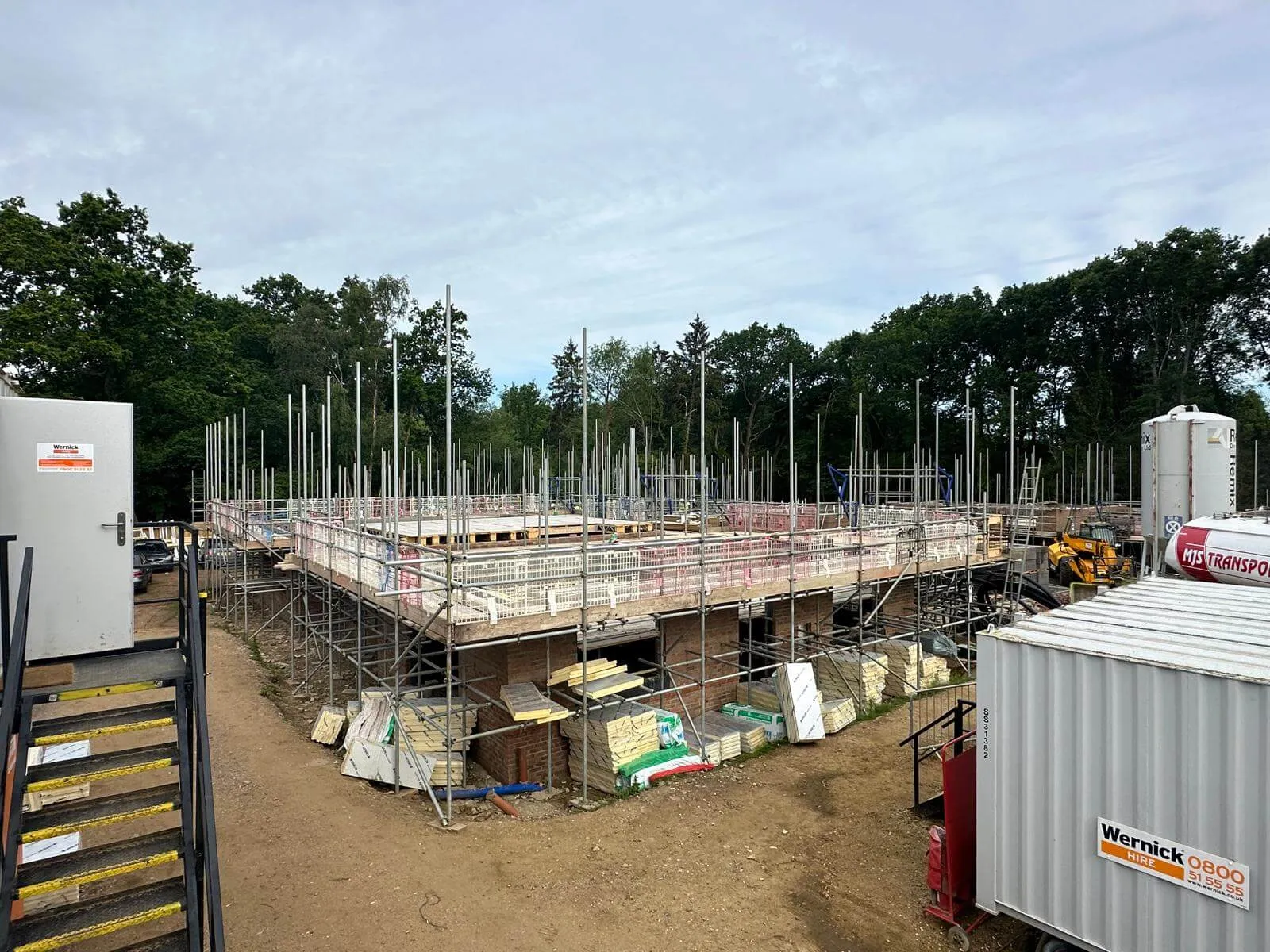
New build scaffolding sequenced to your development programme
Access that moves with the build rather than sitting in the way of it — phased, adapted and struck plot by plot so your trades are never waiting on the scaffolder.
Free site visit usually within 48 hours · Phone answered 24 hours · 19-strong team from one yard in Iver
25 years
Curtis in the trade
19 people
Our own team
4.8 from 29
Google rating
12 weeks
Standard hire
Within 48 hours
Free site visit
Overview
What new build scaffolding has to do
New build scaffolding is a different job to a one-off house scaffold. On a development, the access is not a single structure erected once and struck at the end — it is a rolling operation that follows the build: up as the brickwork rises, adapted for the roof, adapted again for the render or cladding, struck on one plot while another is going up.
That means the scaffolder is part of the programme rather than a supplier who visits twice. Lifts have to be raised in step with the masonry gangs. Loading bays have to be where the crane or telehandler can actually reach. Access has to be released for the scaffolding to come down without holding up the landscaping and the drives. And every one of those moves has to happen on a date that was agreed weeks earlier.
We work with developers and main contractors on phased new build sites across Berkshire, Buckinghamshire, London, Surrey, Middlesex, Oxfordshire and Hertfordshire, from our yard at Seven Hills Farm in Iver, minutes from the M4 at Junction 5. Curtis has twenty-five years in the trade, Andrew runs the operation alongside him, and there are nineteen people on the team.
That size matters on development work. It is enough to hold a phased site properly with our own labour, and small enough that when you call about next week's lift raise you speak to someone who knows your plot numbers.
What it costs to get wrong
What happens when this is left, rushed or under-specified
On a development, scaffolding failures do not show up as accidents. They show up as a programme that keeps slipping a week at a time.
Trades standing while a lift is raised
Bricklayers who cannot get any higher, roofers who cannot start, renderers waiting for a lift to be dropped — every one of those is a paid gang doing nothing, and it happens whenever the scaffolder is not on the programme.
Scaffold in the way of the next trade
Access left standing past its usefulness blocks drives, landscaping, drainage and external works, pushing the plot's completion date and holding up handover.
Loading bays in the wrong place
A bay the telehandler cannot reach means materials handled twice, or an adaptation midway through. Getting it right first time is a conversation at the start, not a fix later.
Sequence changes nobody was told about
Plots get resequenced constantly. A scaffolder who is not in the loop turns up to the wrong plot, or does not turn up at all, and the delay lands on the trade behind them.
Temporary works paperwork chased late
Bridged sections, loading bays and non-standard structures need designs and calculations. Requested the week they are due, they hold the site up; planned in, they do not.
The mistakes we see most often
- Treating scaffolding as a single line item rather than a phased package that follows the build.
- Choosing on price per plot without checking whether the contractor can hold dates across a whole site.
- Leaving loading bay positions to the erect day instead of agreeing them with the site manager.
- Not flagging the boundary, drainage and level constraints on plots before the scaffold is priced.
- Assuming the scaffold can come down before the external works are ready for it to.
Our process
How a job runs, start to finish
The same six steps on every job, whether it is one chimney or a phased commercial programme.
- 01
Call or send the details
Tell us the site address, what the scaffold is for and roughly when you need it. The phone is answered 24 hours a day.
- 02
Free site visit
Curtis, Andrew or one of the team comes out and measures up properly — usually within 48 hours of your enquiry.
- 03
Written quote, no obligation
You get a clear price for your job, based on what we saw on site rather than an average. No charge for the visit or the quote.
- 04
Agreed erect date
We book a date and we work to it. If a licence is needed for the footway, we flag that before the date is set.
- 05
Erected, checked and handed over
The scaffold goes up, gets checked, and your trades get on with the work. Standard hire period is 12 weeks.
- 06
Adaptations and dismantle
Need a lift added or a section moved? Call us. When the job is done we strike it on the agreed day and leave the site clean.
What you get
What you actually get from new build development scaffolding done properly
Concrete outcomes, priced from your site and delivered on the dates we agree.
Dates that hold across the whole site
The single most repeated point in our Google reviews is that we do what we say we will do. On a phased development, that is the entire value.
Adaptations treated as normal, not as a favour
Lift raises, bay changes, part strikes and re-erects are the everyday work of a development. Call us and it gets booked in.
Our own labour, one yard
Nineteen people working from Iver, no sub-contracted third party arriving on your site who has never seen the drawings.
One contractor for the whole access package
Access scaffolds, staircase towers, loading bays, temporary roofs, back propping and designed schemes all from the same team on the same site.
Priced from the drawings and the site
A free site visit, usually within 48 hours, and a written price based on the plots and the phasing rather than a generic rate.
Available when the site is
The phone is answered 24 hours a day, which matters on a site that starts at seven and has a delivery at six.
In detail
How the access package runs through a development
The scaffold on a new build plot changes shape several times. Understanding that sequence is what keeps a development moving.
Early stages: substructure and frame
Before the main access goes up, sites often need edge protection to excavations and slab edges, access into and out of the substructure, and back propping where a frame is being loaded before it has reached strength.
Getting the scaffolder on site at this stage rather than at first lift is usually what avoids the first round of improvised access.
Rising with the masonry
As the brickwork goes up, the scaffold rises with it, lift by lift, so the gang always has a working platform at the right height. On new masonry a putlog arrangement is often the efficient choice, with independents where the wall cannot take putlogs or the ground dictates otherwise.
The rhythm matters more than the structure: the lift has to be raised when the gang needs it, not three days later. That is a scheduling commitment, and it is the one most often broken by contractors who are stretched across too many sites.
Roof stage and edge protection
At roof level the scaffold provides edge protection along the eaves and gables, with access to the ridge where needed, and a temporary roof over the top where the structure has to stay dry through a long roofing period or a winter programme.
Roof stage is also where loading and material handling peaks, so bay positions and capacities get checked against what is actually being lifted.
Loading bays, towers and material handling
Loading bays are built for the load, positioned for the telehandler or crane, and rated so the site knows what can be landed on them. Staircase towers give the trades a proper route up and down rather than a ladder shared by five gangs.
Both are worth agreeing with the site manager before the first plot goes up, because moving them later is the definition of avoidable work.
External finishes and adaptations
Render, cladding, brick slips, fascias and windows all want the scaffold in slightly different configurations. Bays get opened for window installation, lifts get repositioned for the render team, and sections get sheeted where the finish needs weather protection.
Planning these adaptations into the programme, rather than requesting them ad hoc, is what keeps the finishing trades moving through the plots at a steady rate.
Phased strike and handover
Coming down is as programmed as going up. Plots are struck in sequence so that drives, drainage, landscaping and final inspections can proceed, and the material leaves site rather than being stacked in the way.
We strike on the agreed day and leave the plot clean, which on a development is what stops the last four weeks before handover becoming a scramble.
Materials and methods we use
- Independent and putlog scaffolds rising with the masonry
- Roof-level edge protection to eaves, gables and verges
- Rated loading bays positioned for telehandler or crane access
- Staircase towers serving multiple trades and levels
- Temporary roofs over winter and extended roofing programmes
- Back propping and shoring during frame and substructure stages
- Sheeting and debris netting where finishes need protection
- Designed schemes with loading calculations for bridged and loaded structures
Domestic work
- One-off new houses and self-build projects
- Access adapted through masonry, roof, render and window stages
- Bridging over drives, drainage runs and level changes
- Edge protection for roofers and finishing trades
- Prompt strike so drives and landscaping can be completed
- Free site visit, written price and twelve-week standard hire
Commercial work
- Multi-plot housing developments scheduled plot by plot
- Mixed-use and commercial new build with phased access
- Integration with the main contractor's temporary works procedure
- Loading bays, hoist support and staircase towers for site logistics
- Long programme hire agreed and priced upfront
- Coordination with site management on sequence changes
FAQs
New Build Development Scaffolding: common questions
Cost, timescales, hire periods and how the job actually runs.
How is new build scaffolding priced?+
Usually against the plots and the phasing rather than as a single lump. We come out for a free site visit, look at the drawings and the site, and give you a written price covering the erect, the adaptations and the strike sequence.
Can you hold dates across a whole development?+
That is the part of the job we are known for. Our Google reviews from contractors keep saying the same thing — the scaffold is there when we said it would be. It is why developers come back.
How quickly can you raise a lift when the gang needs it?+
Tell us the programme and we will schedule the raises into it. Where a sequence changes at short notice, call us — the phone is answered 24 hours a day and we will tell you honestly what we can do.
Do you provide loading bays and staircase towers?+
Yes, both, as part of the same package. Bay positions and ratings are agreed with the site manager before the first plot goes up.
Can you supply designs and loading calculations?+
Yes. Bridged sections, loading bays and other non-standard structures come with a designed scheme and calculations for your temporary works coordinator.
What is the hire period on a long development?+
Our standard hire period is twelve weeks. On a development that runs longer, the period is agreed and priced at the start rather than added on later.
Do you do back propping during the frame stage?+
Yes — back propping and shoring are part of what we do, so the early stages and the access package come from the same contractor.
Do you use sub-contract labour?+
No. There are nineteen people on our team and the work is done by them, from our yard in Iver.
Which areas do you cover for new build work?+
Berkshire, Buckinghamshire, London, Surrey, Hampshire, Oxfordshire, Hertfordshire, Middlesex, West Sussex and Wiltshire, with the M4 corridor and West London being our busiest patch.
How do you handle the strike sequence?+
Plot by plot, on agreed dates, so external works and handover are not held up. Material leaves the plot rather than being stacked out of the way.
If you have a development coming out of the ground and you want access that keeps pace with it, call us with the site and the programme and we will come out.
Drawings and phasing plans can go through the contact form and we will come back to you with a date for the visit.
Related services
Scaffolding Erection and Hire
Read moreStaircase Towers
Read moreShoring and Back Propping
Read moreTemporary Roofs
Read moreWhere we deliver this service
New Build Development Scaffolding is available across all ten counties we cover from our yard in Iver. You can also see every service we offer, read about ATC Scaffolding or send us the details of your job.
Next step
Access that keeps pace with your build programme
Send us the site, the plot count and the sequence. We will come out free of charge and price a phased scaffolding package with dates you can build a programme around.
Phone answered 24 hours · Free quotes · 12-week standard hire period