
Scaffolding service
Scaffold staircase towers for busy sites across London and the Home Counties
Stop paying skilled trades to climb ladders. A staircase tower moves people and materials up and down all day without slowing anybody down.
Free site visit usually within 48 hours · Phone answered 24 hours · 12-week standard hire period
25 years
Curtis in the trade
19 people
Our own team
4.8 from 29
Google rating
12 weeks
Standard hire
Within 48 hours
Free site visit
Overview
What a staircase tower is and when it earns its place
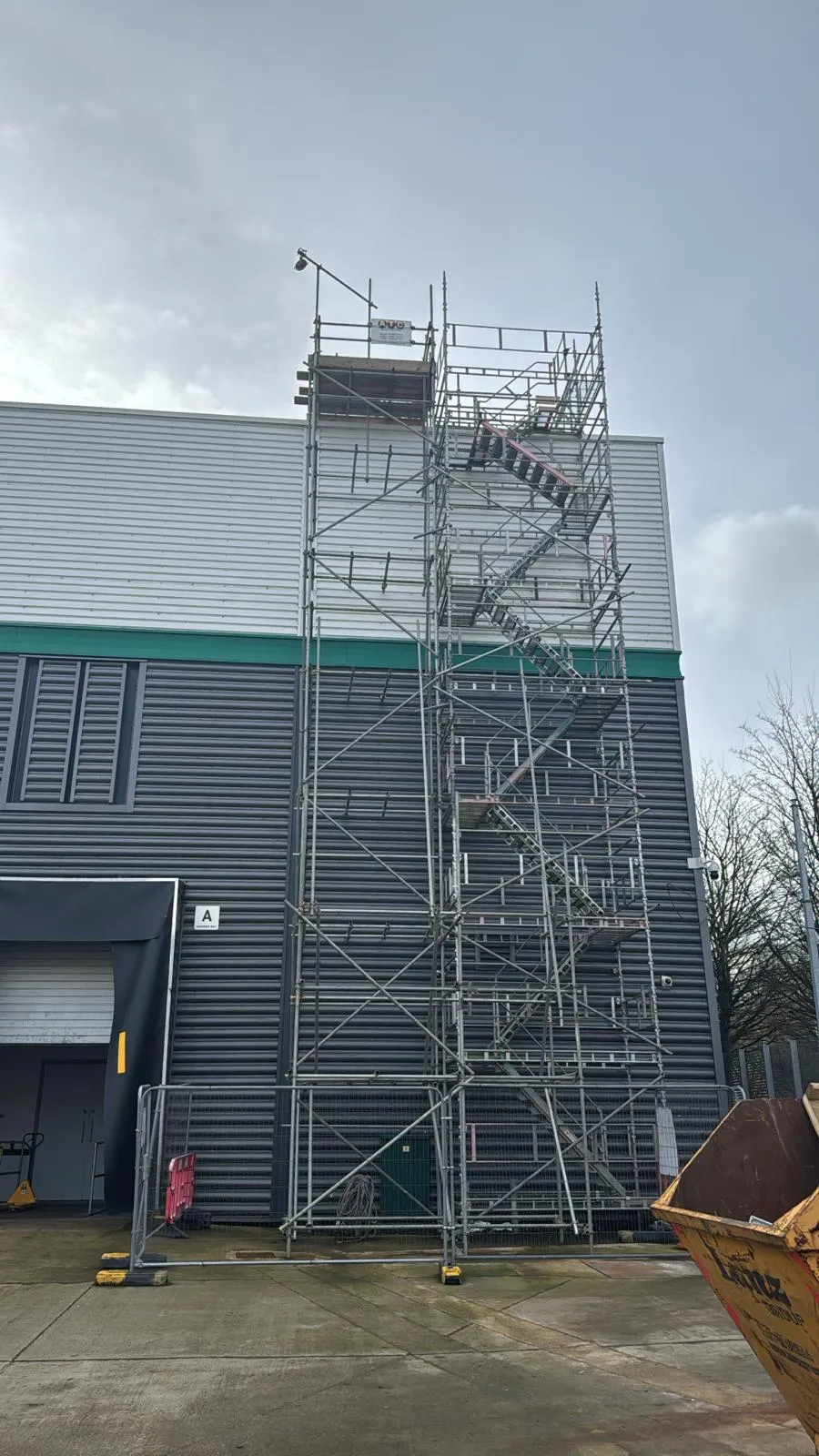
A staircase tower is a scaffold structure containing a run of proper stair flights with handrails and landings, giving safe pedestrian access between ground level and the working lifts of a scaffold, or between floors of a building under construction.
It replaces ladder access. On a small job, a ladder is fine. On a site where fifteen people are going up and down all day carrying tools and materials, the ladder becomes the bottleneck and the biggest single fall risk on the job.
Staircase towers are standard on new build developments, larger refurbishments, commercial sites and any project where the same access route is used continuously. They are also used where the people using the access are not scaffolders — surveyors, clients, inspectors, M&E contractors and delivery crews all move far more comfortably and safely on stairs than on a ladder.
We supply and erect staircase towers from our yard in Iver across Berkshire, Buckinghamshire, London, Surrey, Middlesex and the surrounding counties, either as part of a full access scaffold or as a standalone structure serving somebody else's works. There are nineteen people on the team, and Curtis has twenty-five years in the trade.
What it costs to get wrong
What happens when this is left, rushed or under-specified
Ladder access on a busy site is one of those decisions that looks like a saving right up until the first incident or the first programme slip.
Falls from ladders are the classic site injury
Climbing with materials, three points of contact abandoned, wet rungs in winter — these are the circumstances behind a large share of construction falls, and every one of them is a circumstance a staircase removes.
Time lost, every trip, all day
A minute lost each way, twenty times a day, across a team, is hours a week of paid time that produces nothing. On a long programme it adds up to far more than the tower cost.
Materials handled badly or not at all
When the only route up is a ladder, materials get thrown, hoisted awkwardly or left at the bottom until someone has a spare pair of hands. All three cost time or cause damage.
Non-trade visitors cannot get to the work
Clients and inspectors will not climb a ladder, and should not be asked to. Inspections get delayed, decisions get delayed, and the programme waits on them.
Nowhere safe to evacuate to
In an emergency, a single ladder is a poor escape route for a floor full of people. Stairs with landings are a proper one.
The mistakes we see most often
- Putting the tower where the scaffold is convenient rather than where people actually enter the building.
- Sizing it for one trade when four will be using it by month two.
- Forgetting that the tower needs ground and a base like any other scaffold.
- Leaving it off the initial quote and adding it after the main scaffold is up.
- Assuming a ladder is sufficient because the job is short — programmes always run longer.
Our process
How a job runs, start to finish
The same six steps on every job, whether it is one chimney or a phased commercial programme.
- 01
Call or send the details
Tell us the site address, what the scaffold is for and roughly when you need it. The phone is answered 24 hours a day.
- 02
Free site visit
Curtis, Andrew or one of the team comes out and measures up properly — usually within 48 hours of your enquiry.
- 03
Written quote, no obligation
You get a clear price for your job, based on what we saw on site rather than an average. No charge for the visit or the quote.
- 04
Agreed erect date
We book a date and we work to it. If a licence is needed for the footway, we flag that before the date is set.
- 05
Erected, checked and handed over
The scaffold goes up, gets checked, and your trades get on with the work. Standard hire period is 12 weeks.
- 06
Adaptations and dismantle
Need a lift added or a section moved? Call us. When the job is done we strike it on the agreed day and leave the site clean.
What you get
What you actually get from staircase towers done properly
Concrete outcomes, priced from your site and delivered on the dates we agree.
People move faster and safer
Proper flights with handrails and landings mean two hands free, normal walking pace and no queue at the bottom.
Materials go up with the person carrying them
Tools, fixings and small materials travel with the operative instead of waiting for a lift or being hauled up on a rope.
Everyone can use it
Trades, clients, inspectors and delivery crews all have safe access to the working level without a ladder conversation.
Fits with the access scaffold
Built into the same structure, on the same hire, with landings at each working lift and one team responsible for the lot.
Repositioned as the site changes
Site entrances move, phases hand over, footprints change. Call us and we will move or extend it.
Priced from the site
Height, ground, position and the number of landings all matter, which is why the price follows a free site visit within 48 hours rather than a phone estimate.
In detail
How staircase towers are configured
A staircase tower is a simple idea with a set of practical decisions behind it — position, width, landings, ground and how it ties to everything else.
Position and site logistics
The tower goes where people arrive, not where the scaffolder finds it easiest. That usually means near the site entrance, the welfare compound or the main door, with a clear walking route to it that does not cross a delivery or plant route.
On phased sites the right position changes as the job progresses. It is worth telling us the sequence at the survey so we can position it once rather than move it three times.
Stair units, widths and landings
Stair flights are prefabricated units within a scaffold frame, with a half landing between flights and a full landing at every level the tower serves.
Width is a real decision on a busy site: a tower that lets two people pass keeps traffic flowing in both directions, and on a large site that matters more than the extra material costs.
Handrails, edges and finishes
Handrails run continuously on both sides of every flight, with guard rails and toe boards to all landings and openings. Treads are non-slip units rather than boards laid across bearers.
Where the tower is exposed, it can be netted or sheeted to make it more comfortable to use in wind and rain, bearing in mind that sheeting increases wind loading and changes the tie pattern.
Foundations and ground
A staircase tower is heavier and more concentrated than the scaffold beside it, and it takes the dynamic load of people moving. The base needs sole boards or spreaders onto ground that can take it.
Soft ground, made-up ground, drain runs and basement lightwells all get checked at the survey — a tower that settles is not a tower anybody wants to use.
Tying in and connecting to working lifts
The tower is tied to the building or the adjacent scaffold for stability, and landings are set to match the boarded lifts so people step straight out onto the working platform without a change in level.
That alignment is a detail that gets missed on cheap jobs, and it is instantly obvious to everyone who uses it every morning.
Standalone towers and internal access
Not every staircase tower serves a scaffold. Standalone towers give access to upper floors during construction, over embankments and level changes, and into buildings where the permanent stair is being replaced.
Internally, towers are used inside atria, plant rooms and industrial buildings where continuous access to high level is needed for weeks rather than hours.
Materials and methods we use
- Prefabricated stair units with non-slip treads
- Full and half landings at every level served
- Continuous double handrails to both sides of each flight
- Guard rails and toe boards to all landings and openings
- Sole boards and spreaders to the tower base
- Ties into the building or adjacent access scaffold
- Netting or sheeting on exposed towers where useful
- Wider configurations where two-way foot traffic is needed
Domestic work
- Larger domestic projects with long programmes
- Loft conversions and full refurbishments with continuous access
- Sites where the permanent staircase is out of action
- Access over level changes, embankments and sloping gardens
- Safe access for clients and building control to inspect the work
- Free site visit, written price and twelve-week standard hire
Commercial work
- New build developments needing access to upper floors during construction
- Multi-trade sites with continuous foot traffic between levels
- Standalone towers serving another contractor's works
- Internal towers in atria, plant rooms and industrial buildings
- Landings matched to working lifts across phased scaffolds
- Repositioning as the site sequence and entrances change
FAQs
Staircase Towers: common questions
Cost, timescales, hire periods and how the job actually runs.
How much does a staircase tower cost?+
It depends on the height, the number of landings, the width and the ground it stands on. We price it after a free site visit, usually within 48 hours of your call, and there is no charge for the visit or the written quote.
Can I add one to a scaffold that is already up?+
Usually yes, though it is cheaper and quicker to include it when the main scaffold is priced. Call us and we will come and look at where it could go.
How long does it take to erect?+
A tower serving a couple of lifts is normally a day or less. Taller towers with multiple landings take longer, and we will tell you what to expect with the price.
How high can a staircase tower go?+
Heights well beyond typical building scaffolds are achievable with the right base, bracing and ties. What matters is the ground and the tie points, which is what we assess at the survey.
Can two people pass on the stairs?+
With a wider configuration, yes. On a busy multi-trade site it is usually worth it, and we will price both options if you are not sure.
Does it need to be tied to the building?+
In almost all cases, yes — a tower is tied for stability, either into the structure or into the adjacent scaffold.
How long is the hire period?+
Our standard hire period is twelve weeks. Long-running sites are priced upfront for the period they actually need.
Can it be moved as the site changes?+
Yes. Site entrances and phases move all the time — call us and we will reposition it.
Can non-trade visitors use it?+
That is one of the main reasons to have one. Clients, architects and inspectors can reach the working level without being asked to climb a ladder.
Which areas do you supply staircase towers in?+
Berkshire, Buckinghamshire, London, Surrey, Hampshire, Oxfordshire, Hertfordshire, Middlesex, West Sussex and Wiltshire, from our yard at Seven Hills Farm in Iver.
If your site has more than a couple of people going up and down every day, a staircase tower usually pays for itself in the time it gives back. Call us with the height and the site layout and we will come out.
You can also send the details through the contact form and we will book a visit.
Related services
Scaffolding Erection and Hire
Read moreNew Build Development Scaffolding
Read moreBirdcage Scaffolds
Read moreData Centre Scaffolding
Read moreWhere we deliver this service
Staircase Towers is available across all ten counties we cover from our yard in Iver. You can also see every service we offer, read about ATC Scaffolding or send us the details of your job.
Next step
Give your site an access route people can actually use
Tell us the height, the position and how many people are using it. We will come out free of charge and price a staircase tower that fits the site and the programme.
Phone answered 24 hours · Free quotes · 12-week standard hire period