
Scaffolding service
Scaffolding erection and hire in Iver, Slough and London
Access that goes up on the date we agreed, so your roofers, bricklayers and renderers start on the morning they were booked instead of standing in a driveway waiting.
Free site visit usually within 48 hours · Phone answered 24 hours · 4.8 from 29 Google reviews
25 years
Curtis in the trade
19 people
Our own team
4.8 from 29
Google rating
12 weeks
Standard hire
Within 48 hours
Free site visit
Overview
What scaffolding erection and hire actually covers
Scaffolding erection and hire is the core of what ATC Scaffolding does. We supply the tube, fittings, boards and system components, we build the structure on your site, we hand it over ready to work from, and it stays with you for the hire period while your trades get on. When the work is finished we come back, strike it and take everything away. You are not buying materials or storing anything — you are buying a working platform for the length of the job and the labour that puts it up and takes it down safely.
In practice a hire covers more than the erect. It covers the measure-up beforehand, so the lift heights suit the work rather than a standard drawing. It covers loading the wagon with the right kit, working out where the base sits on the ground you actually have, and setting the ties into the structure. It covers the adaptations partway through when the roofer wants a lift raised or the render team needs a section moved. And it covers the dismantle, on the agreed day, with the site left clean.
Our standard hire period is twelve weeks. That is deliberately long enough to absorb the normal slippage of a real project — bad weather, a late materials delivery, a trade who overran on the job before yours — without a hire extension conversation halfway through. If a job needs longer than twelve weeks, that is a conversation we have upfront when we price it, not a surprise invoice later.
Curtis has been in the scaffolding trade for twenty-five years and runs the company with Andrew. There are nineteen people on the team, all working from the yard at Seven Hills Farm in Iver, which sits minutes from the M4 at Junction 5. That location is why we can hold to short lead times across Berkshire, Buckinghamshire, London, Surrey, Middlesex and Hertfordshire — the wagon leaves early and gets there before the morning is gone.
What it costs to get wrong
What happens when this is left, rushed or under-specified
Access is the first thing on site and the thing everything else waits for. When it is wrong or late, the cost lands on the trades behind it, not on the scaffold.
Every day the scaffold is late, a trade is idle
A roofing gang that turns up to a bare wall does not wait quietly — they go to the next job and you go to the back of their diary. A two-day delay on the access can push the actual work back by two or three weeks, and on a domestic project that usually means another spell of open roof or exposed brickwork through whatever weather arrives.
Under-specified access slows the work it was built for
A scaffold with lifts at the wrong height, no proper boarding out at the working level, or nowhere to land materials forces the trade to work awkwardly. Awkward work is slow work, and slow work on day rates costs more than the difference between a proper scaffold and a cheap one ever saved.
Ladders and towers on work they were never meant for
Cutting the scaffold out of the budget does not remove the need for height access, it just moves it onto ladders, hop-ups and small towers. That is where falls happen, and it is where insurers and the HSE look first if something does.
Ground and structure problems found on erect day
Soft verges, drain runs, basement lightwells, a pavement that needs a licence, a wall that will not take a tie — every one of these stops an erect dead if it is discovered on the morning rather than at a site visit. That is exactly why our quote comes after somebody has stood on the site, not off a photograph.
Hire that quietly outruns the job
Short hire periods look cheap on the quote and then extend, week by week, while the job runs its normal course. Our twelve-week standard hire exists so the price you agree is still the price when the work finishes.
The mistakes we see most often
- Booking the trade before booking the scaffold, then discovering the access cannot be up in time.
- Comparing quotes on headline price without checking the hire period each one includes.
- Assuming a footway or highway licence is somebody else's job — it needs flagging before an erect date is set.
- Leaving no allowance for adaptations, then paying for a rushed change midway through the job.
- Accepting a price given over the phone from a description, which almost always changes once someone sees the site.
Our process
How a job runs, start to finish
The same six steps on every job, whether it is one chimney or a phased commercial programme.
- 01
Call or send the details
Tell us the site address, what the scaffold is for and roughly when you need it. The phone is answered 24 hours a day.
- 02
Free site visit
Curtis, Andrew or one of the team comes out and measures up properly — usually within 48 hours of your enquiry.
- 03
Written quote, no obligation
You get a clear price for your job, based on what we saw on site rather than an average. No charge for the visit or the quote.
- 04
Agreed erect date
We book a date and we work to it. If a licence is needed for the footway, we flag that before the date is set.
- 05
Erected, checked and handed over
The scaffold goes up, gets checked, and your trades get on with the work. Standard hire period is 12 weeks.
- 06
Adaptations and dismantle
Need a lift added or a section moved? Call us. When the job is done we strike it on the agreed day and leave the site clean.
What you get
What you actually get from scaffolding erection and hire done properly
Concrete outcomes, priced from your site and delivered on the dates we agree.
The erect date is a commitment, not an estimate
We agree a date after we have seen the site and we work to it. The most repeated phrase in our Google reviews is that we do what we say we will do, and it is the whole reason contractors come back.
Priced from the site, not from an average
Every quote follows a free site visit, usually within 48 hours of your call. You get a written price for your job, with no charge for the visit and no obligation to go ahead.
Twelve-week standard hire
Long enough to cover the realistic life of most domestic and commercial jobs, so the budget you set at the start survives contact with the programme.
One team, our own labour
Nineteen people working out of one yard in Iver. The crew that quotes your job is from the same team that erects it, so nothing is lost between the visit and the wagon arriving.
Adaptations without a fight
Need a lift raised, a section moved for a delivery, or a bay taken out for a window? Call us. Changes are part of how jobs actually run and we plan for them.
Answered at any hour
The phone is answered 24 hours a day. If something happens on site at six in the evening, you speak to a person rather than a voicemail box.
In detail
Types of scaffold we erect, and how they are built
Scaffolding erection covers a wide range of structures, and the right one depends on the building, the ground, the work being done and how long it needs to stand. Below is the detail on the configurations we build most often and the decisions behind them.
Independent tied scaffolds
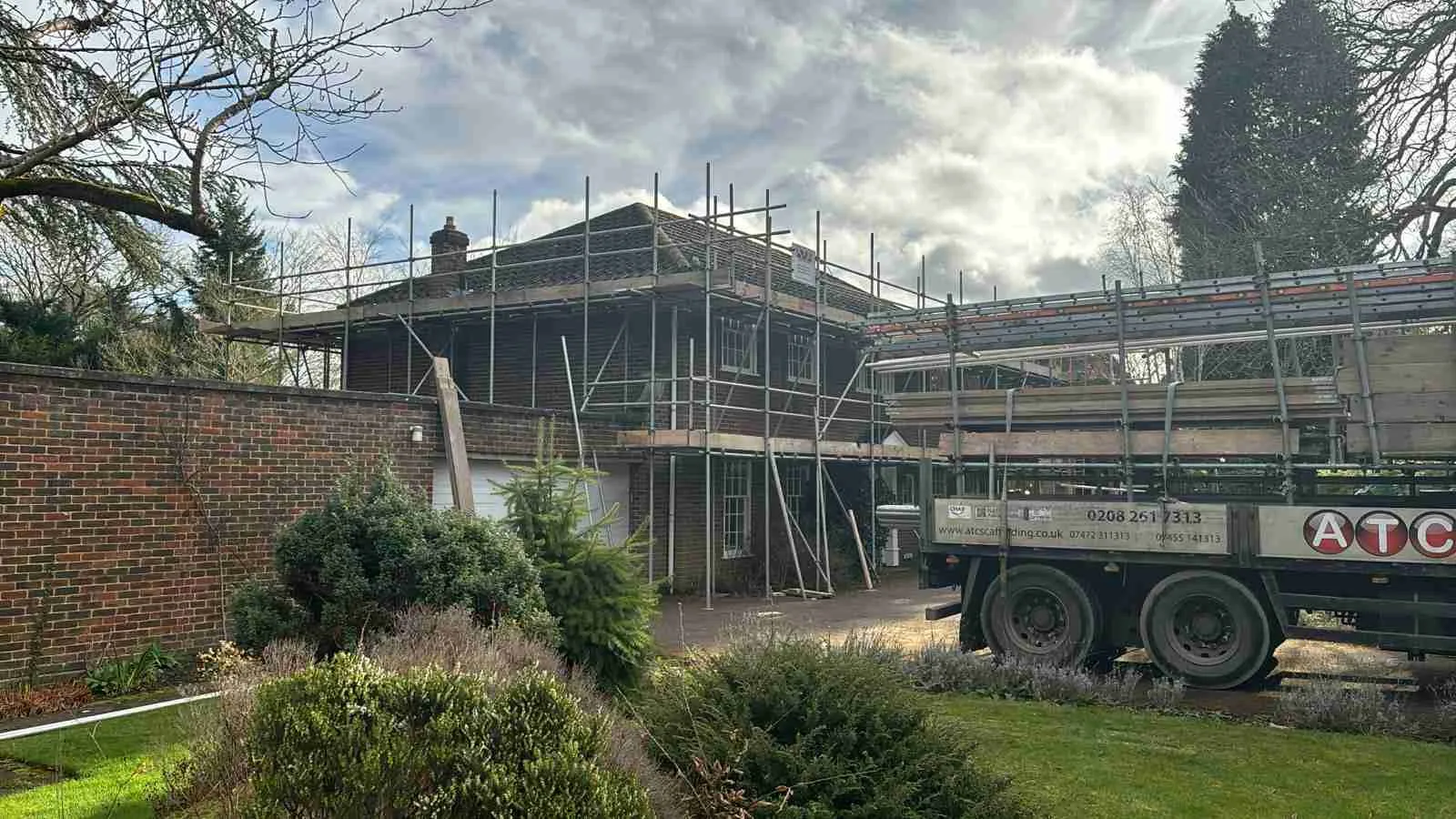
The independent scaffold is the workhorse of the trade and the one on most houses and commercial elevations. Two rows of standards run parallel to the building, joined by ledgers and transoms, boarded out at each working lift and tied back into the structure so the whole frame acts with the building rather than against it.
The details that matter are the ones you cannot see from the pavement: base plates and sole boards spreading the load onto ground that can take it, tie patterns matched to the elevation and the sheeting, guard rails and toe boards at every working lift, and brick guards where materials are being handled over a public footpath. Height, exposure and whether the scaffold is sheeted all change the tie pattern, which is why the site visit matters more than the elevation drawing.
Putlog scaffolds for new brickwork
On new masonry a putlog scaffold uses a single row of standards with flattened-end tubes bedded into the brick joints as the wall rises. It is efficient on a new build gable or garden wall where the brickwork is going up anyway, and it uses less material and less ground space than a full independent.
It only works where the masonry is genuinely load bearing and being built in courses, so it is a new build and extension solution rather than a refurbishment one.
Chimney and roof access scaffolds
Chimney work needs a working platform at ridge level with a safe route to it, which usually means an independent up the elevation, a roof ladder or crawler section over the tiles, and a boarded platform around the stack with edge protection all the way round.
Roof strips and re-covers need edge protection along the eaves and, where the whole covering is off for any length of time, often a temporary roof over the top to keep the structure and the inside of the building dry while the work is carried out.
Loading bays, hoists and material handling
If materials are going up, the scaffold needs somewhere designed to take them. Loading bays are built with heavier duty standards and additional bracing, rated for the load, positioned where the wagon can reach and where the trade actually wants the material.
Getting the bay in the wrong place is one of the most common causes of a mid-job adaptation, so it is one of the things we ask about at the site visit rather than assuming.
Sheeting, netting and debris protection
Monarflex sheeting keeps weather off the works and contains dust and debris; netting does the debris job while letting far more wind through. The trade-off is wind loading: a fully sheeted scaffold catches significantly more wind than an open one, which means more ties and, on exposed sites, a heavier structure.
That is a decision to make at pricing stage. Deciding to sheet a scaffold after it is built usually means going back and adding ties, and that is a return visit nobody budgeted for.
Pavement licences, gantries and public access
Where a scaffold stands on or over a public footway, the local highway authority requires a licence, and on a busy street a pedestrian gantry or fan may be required so people can pass underneath safely.
We flag licence requirements before an erect date is set, because a licence that has not been applied for is the single most common reason a booked erect cannot go ahead. Terraced streets in Slough, Windsor, Uxbridge and the London boroughs are where this comes up most.
Materials and methods we use
- Tube and fitting scaffold for irregular buildings and awkward geometry
- System scaffold where speed and repetition suit the elevation
- Timber and steel scaffold boards, boarded out at every working lift
- Sole boards and base plates for load spreading on soft or made-up ground
- Guard rails, toe boards and brick guards as standard on working lifts
- Monarflex sheeting or debris netting where weather or dust protection is needed
- Ladder access, staircase towers or hoist-served loading bays depending on the job
- Beams and needles where the scaffold has to bridge an obstruction at ground level
Domestic work
- Roof strips, re-covers, chimney rebuilds and repointing
- Rendering, external wall insulation and repainting
- Loft conversions, dormers and single or two-storey extensions
- Fascia, soffit, gutter and window replacement
- Access built around driveways, side returns, conservatories and neighbours' boundaries
- Free site visit, written price, and a hire period that covers the whole job
Commercial work
- Phased scaffolding sequenced to a build or refurbishment programme
- Loading bays, staircase towers and designed structures where loads are higher
- Work around live buildings, occupied floors and public routes
- Coordination with main contractors, roofers, cladding teams and M&E
- Adaptations as the programme moves rather than one fixed structure
- Standard twelve-week hire with longer periods agreed upfront where needed
FAQs
Scaffolding Erection and Hire: common questions
Cost, timescales, hire periods and how the job actually runs.
How much does scaffolding cost?+
It depends on the height, the number of lifts, the width of the elevation, ground conditions, whether it needs sheeting and whether a pavement licence is involved. We do not give prices over the phone from a description, because the price always changes once somebody has seen the site. Instead we come out, measure up and give you a written quote — free, usually within 48 hours of your call, with no obligation.
How long does it take to get a quote?+
We aim to be on site for a free visit within 48 hours of your enquiry. The written price follows shortly after. If your job is urgent, say so when you call — the phone is answered 24 hours a day and we will tell you honestly what we can do.
How long is the hire period?+
Our standard hire period is twelve weeks. If the work is going to run longer than that, tell us at the quote stage and we will price it properly rather than leave it to catch you out later.
How quickly can the scaffold go up?+
Once the quote is accepted and any licence is in place, we agree an erect date and we work to it. Lead times depend on how the diary sits when you call, which is why it is worth calling as early as you can — but the date we give you is a date we hold to, not a hopeful estimate.
How long does the erect itself take?+
A straightforward domestic scaffold to the back or front of a house is usually a morning or a day. A full wrap around a detached property, a large commercial elevation or a phased site is longer and we will tell you what to expect when we quote.
Do I need a licence for scaffolding on the pavement?+
If any part of the scaffold stands on or overhangs a public footway or road, the local council requires a licence. We identify that at the site visit and flag it before an erect date is agreed, so nothing is booked that cannot legally go ahead.
Can the scaffold be changed once it is up?+
Yes. Lifts get raised, bays get opened for windows, sections get moved for deliveries. Call us and we will come and adapt it. It is a normal part of how jobs run, not an argument.
Do you work on domestic jobs as well as commercial?+
Both, from a single chimney to a phased new build development or a data centre programme. The same team, the same yard and the same process apply either way.
Which areas do you cover for scaffolding hire?+
We work from Iver across Berkshire, Buckinghamshire, London, Surrey, Hampshire, Oxfordshire, Hertfordshire, Middlesex, West Sussex and Wiltshire. Slough, Windsor, Uxbridge and West London are on our doorstep; the outer counties are planned in with a little more notice.
How do I pay?+
By bank transfer. Details are on the invoice, and quotes and site visits are free.
If you have a job coming up and you want a straight answer on price and timing, the fastest route is to call. Tell us the site address, what the scaffold is for and roughly when you need it, and we will book a visit.
If you would rather send the details in writing, use the enquiry form on our contact page and we will come back to you.
Related services
Temporary Roofs
Read moreStaircase Towers
Read moreScaffold Design and Loading Calculations
Read moreBirdcage Scaffolds
Read moreWhere we deliver this service
Scaffolding Erection and Hire is available across all ten counties we cover from our yard in Iver. You can also see every service we offer, read about ATC Scaffolding or send us the details of your job.
Next step
Get a written scaffolding price after a free site visit
Tell us where the site is and what the access is for. We will come out, measure up properly and give you a clear written price — no charge, no obligation, usually within 48 hours of your call.
Phone answered 24 hours · Free quotes · 12-week standard hire period